
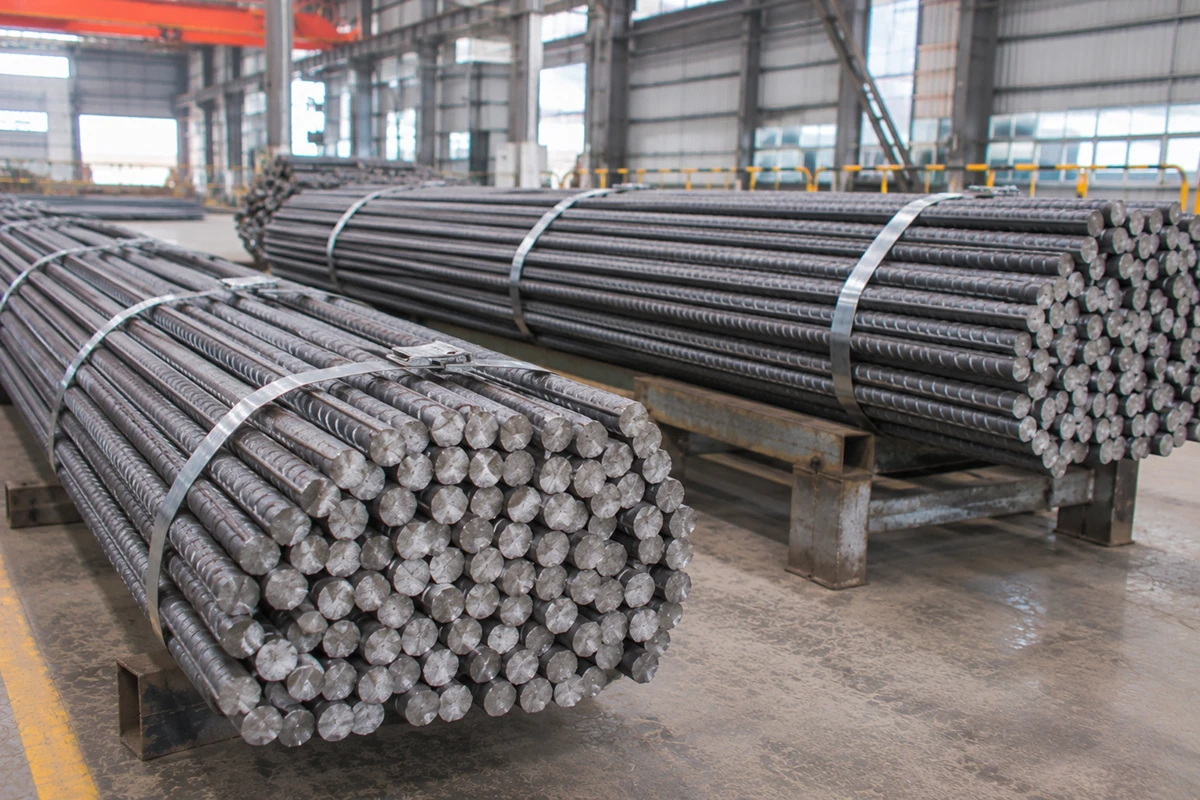
400 MPa / STANDARD GRADE
HRB400 Steel Rebar
Hot-rolled ribbed bar for reinforced concrete applications where the specified ordinary 400 MPa strength class is accepted.
- Yield: ≥400 MPa
- Tensile: ≥540 MPa
- Agt: ≥7.5%
- Rolled mark: 4
Source hot-rolled ribbed reinforcing steel bars to GB 1499.2-2024. Compare HRB400, HRB400E, HRB500 and HRB500E by strength class, seismic-grade requirements, nominal diameter and mill test documentation—then request a project-specific bulk quotation.
Share your grade, nominal diameter, bar lengths, quantity by size, inspection requirements and destination port.
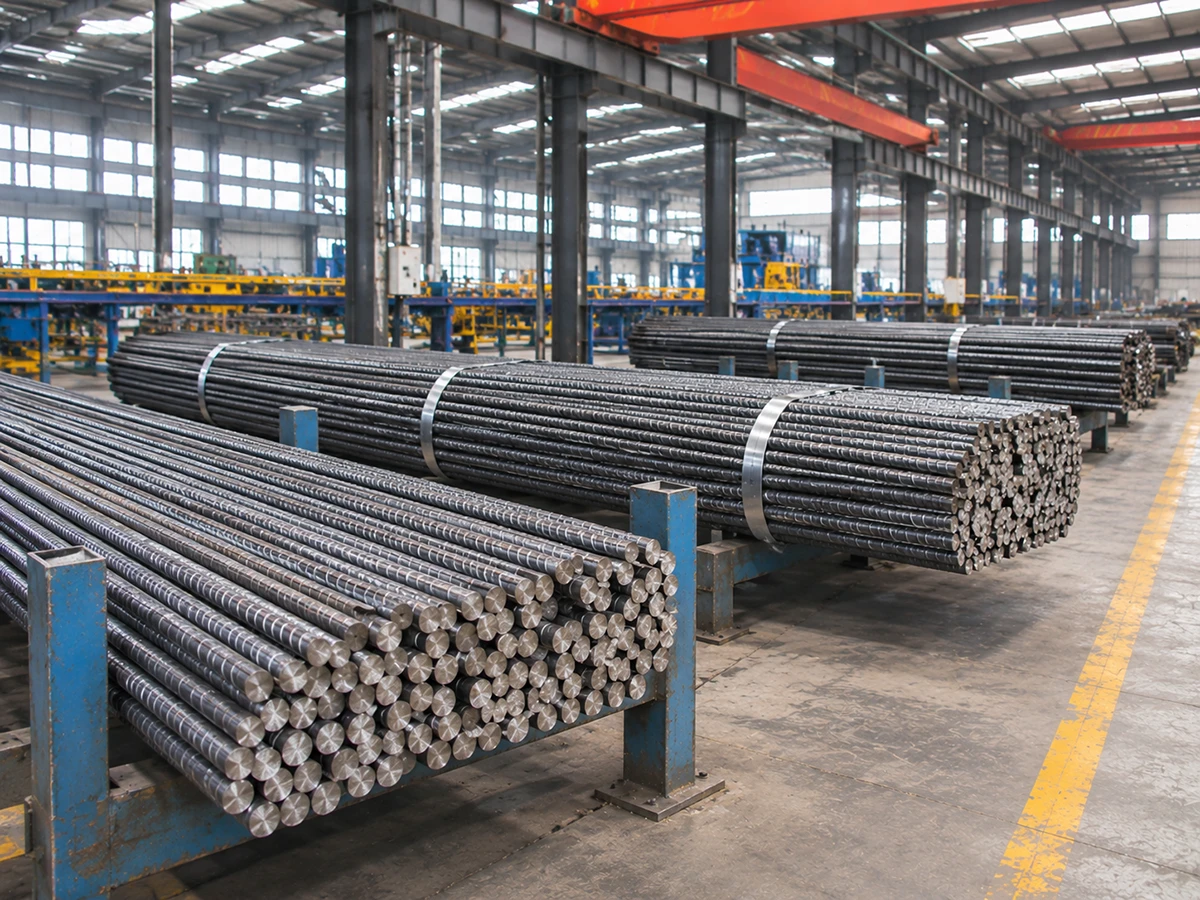
A product-family overview for contractors, reinforcement fabricators, distributors and engineering procurement teams.
GB Steel Rebar refers here to hot-rolled deformed bars supplied against the Chinese national standard GB 1499.2-2024. Surface ribs provide mechanical interlock with concrete. Grade selection determines specified yield level and whether additional E-grade tensile-ductility controls apply.
For an accurate quotation, specify HRB400, HRB400E, HRB500 or HRB500E, required diameters, cut lengths, quantity per size, packaging, test documentation and your governing design acceptance criteria. Supply and inspection are checked for each quoted grade and manufacturing lot.
The standard also covers further designations, including HRB600 and fine-grain HRBF grades; this page focuses on the four grades with dedicated product pages.
Follow the dedicated grade page for specific properties, dimensions, testing and order considerations.
400 MPa / STANDARD GRADE
Hot-rolled ribbed bar for reinforced concrete applications where the specified ordinary 400 MPa strength class is accepted.
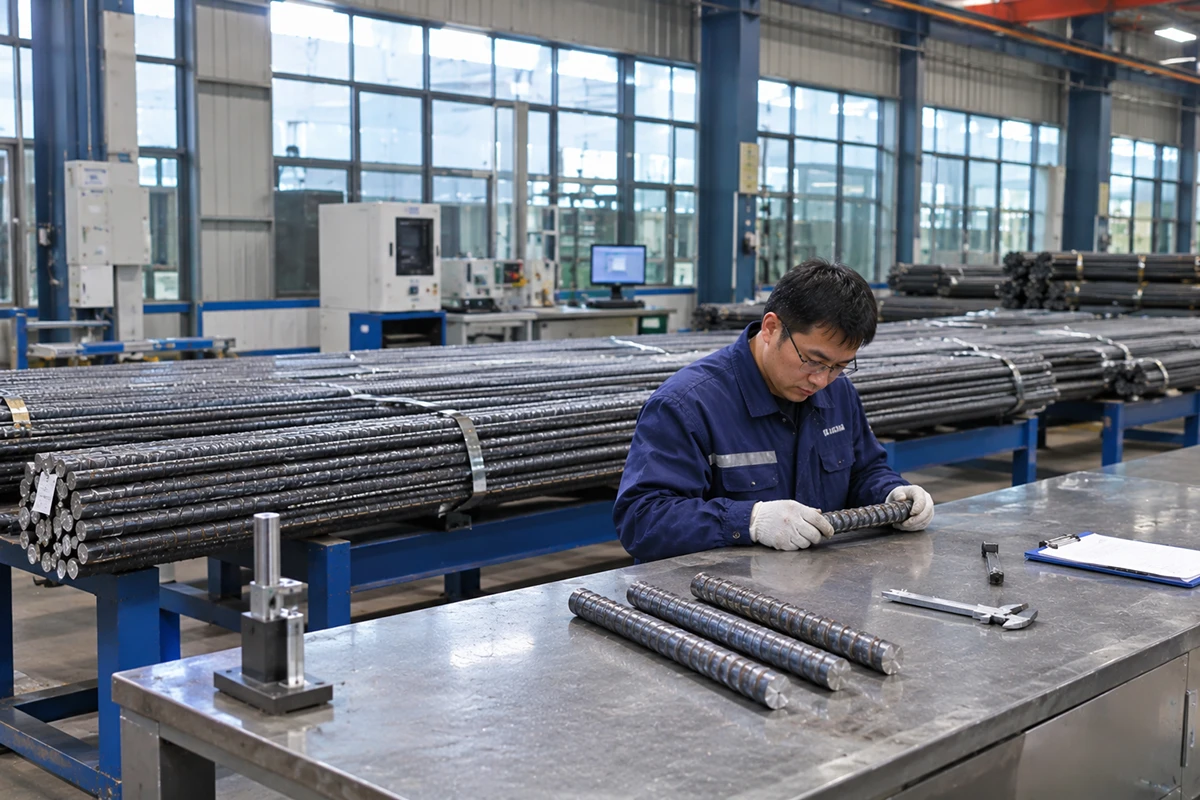
400 MPa / SEISMIC DUCTILITY
400 MPa E-grade reinforcement with controlled actual strength ratios and increased total elongation at maximum force.
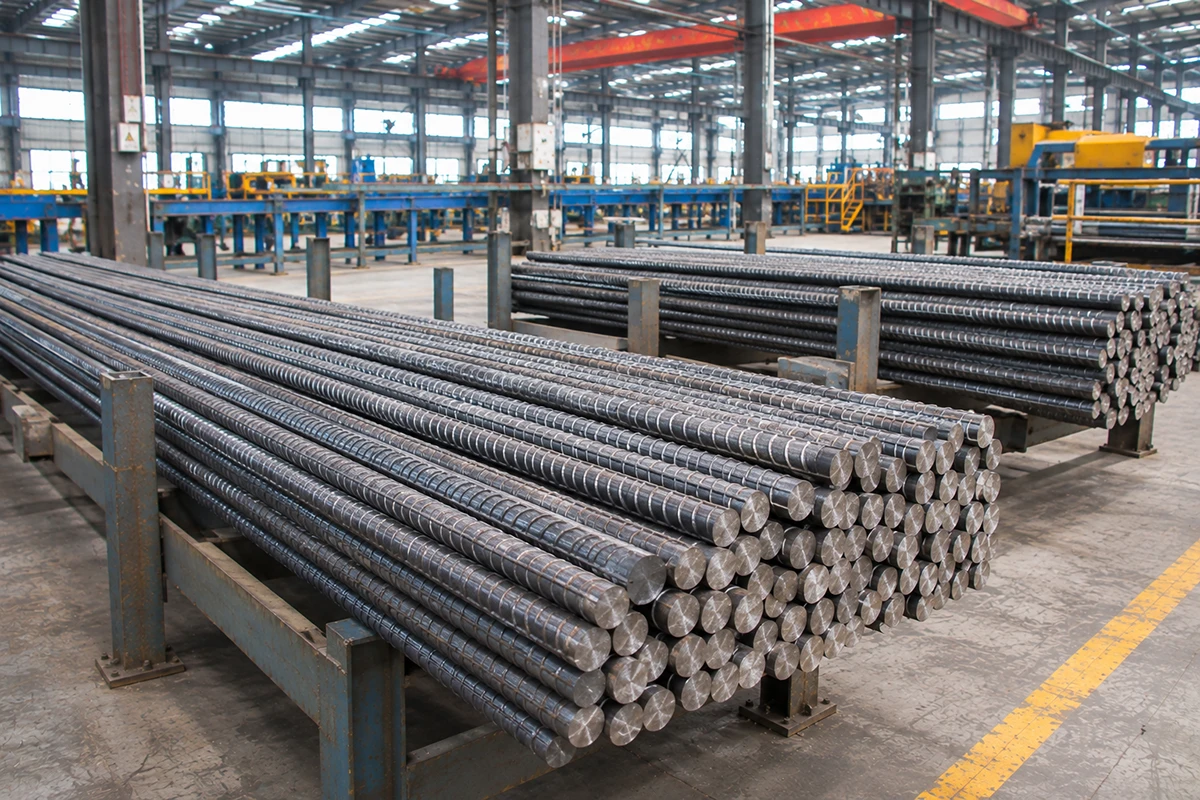
500 MPa / STANDARD GRADE
Higher specified strength class for reinforcement designs that call for ordinary 500 MPa-grade hot-rolled ribbed bars.
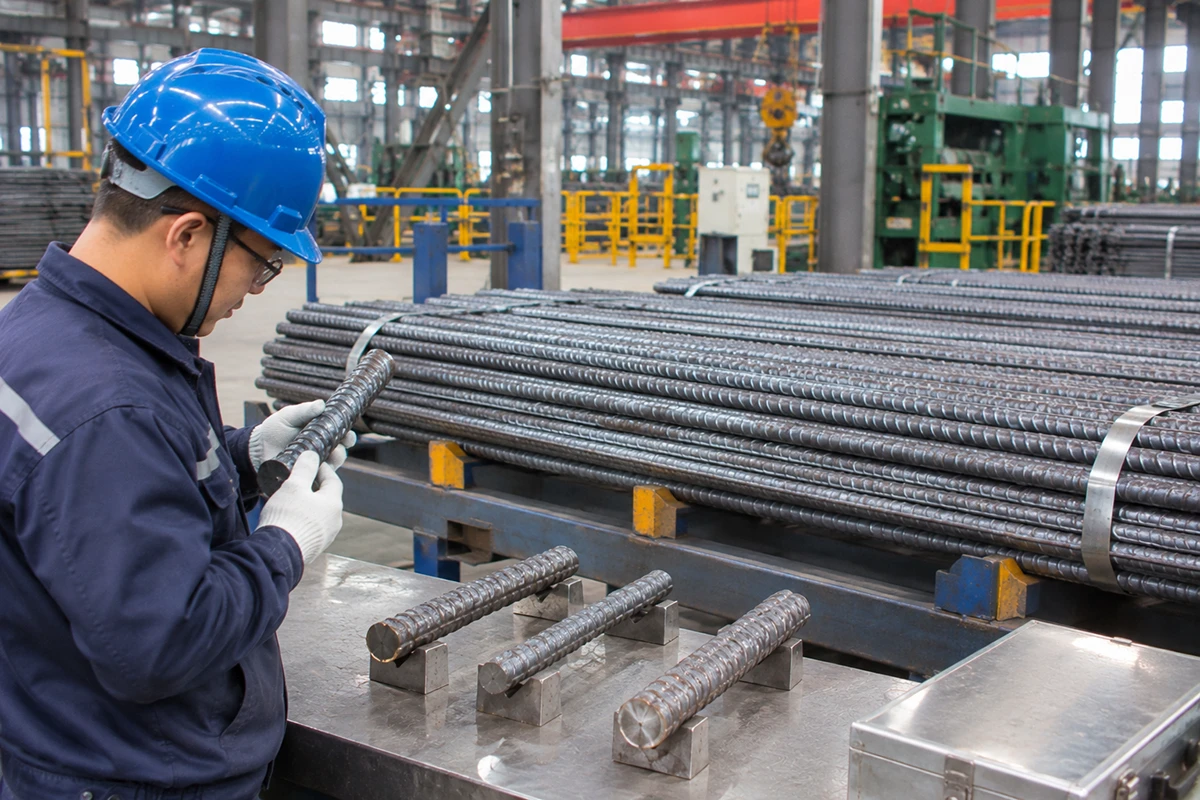
500 MPa / SEISMIC DUCTILITY
500 MPa E-grade reinforcement combining specified tensile strength with controlled actual yield and ductility.
For HRB400E and HRB500E, the contract should include the E designation and applicable test acceptance criteria. Grade, design approval and material traceability must match project requirements.
The current mandatory national standard covers hot-rolled ribbed reinforcing steel for concrete, including classification, dimensions, performance and acceptance.
GB 1499.2-2024 superseded GB/T 1499.2-2018 and came into force on 25 September 2024. It covers ordinary and fine-grained hot-rolled ribbed bars.
The material grade is only one part of project acceptance. Confirm the design code, approved rebar schedule, concrete member detailing, splice procedure and any supplementary testing requirements.
When the project specifies an ASTM, BS or another national system, obtain the necessary engineering approval before changing the standard.
A direct four-grade comparison avoids mixing standard-strength properties with E-grade measured-ratio limits.
| Grade | Yield min (MPa) | Tensile min (MPa) | A min | Agt min | Actual Rm / ReL | Actual ReL / specified ReL | Mark |
|---|---|---|---|---|---|---|---|
| HRB400 | 400 | 540 | 16%* | 7.5% | — | — | 4 |
| HRB400E | 400 | 540 | — | 9.0% | ≥1.25 | ≤1.30 | 4E |
| HRB500 | 500 | 630 | 15%* | 7.5% | — | — | 5 |
| HRB500E | 500 | 630 | — | 9.0% | ≥1.25 | ≤1.30 | 5E |
Reference: GB 1499.2-2024 Table 6. A = elongation after fracture; Agt = total elongation at maximum force. E-grade A is not assigned a minimum in this table. *For ordinary grades, the minimum A may decrease by 1 percentage point at Ø28–40 mm and 2 points above Ø40 mm. Ratios refer to actual measured strengths, not ratios of the listed minima.
Specified limits include measured tensile strength divided by measured yield strength ≥1.25 and measured yield divided by the specified yield level ≤1.30. E-grade Agt is at least 9.0%. Mill results and project design requirements govern acceptance.
Heat-analysis limits inform material verification and planned fabrication; actual test values must come from the ordered heat.
| Grades | C max % | Si max % | Mn max % | P max % | S max % | Ceq max % |
|---|---|---|---|---|---|---|
| HRB400 / HRB400E | 0.25 | 0.80 | 1.60 | 0.045 | 0.045 | 0.54 |
| HRB500 / HRB500E | 0.25 | 0.80 | 1.60 | 0.045 | 0.045 | 0.55 |
Heat-analysis reference limits for the four listed HRB grades under GB 1499.2-2024. Finished-product chemical deviations are governed separately by the standard. Chemical analysis alone does not certify structural suitability.
The specified carbon-equivalent formula is Ceq = C + Mn/6 + (Cr + V + Mo)/5 + (Cu + Ni)/15, using mass percentages. The ordered heat certificate should list values needed for verification.
Grade, diameter, process and applicable joining procedure all matter when discussing weldability.
GB 1499.2-2024 specifies out-of-furnace refining for HRB500E. Include this grade and relevant manufacturing/test documentation clearly in project enquiries.
A published grade description is not a claim of available stock or guaranteed batch composition.
Use nominal mass per metre when planning project steel takeoffs. The raised ribs are already represented in the standard nominal mass system.
| Nominal diameter | Nominal area (mm²) | Mass (kg/m) | 12 m bar (kg) | 12 m × 100 pcs (MT) |
|---|---|---|---|---|
| Ø6 | 28.27 | 0.222 | 2.664 | 0.266 |
| Ø8 | 50.27 | 0.395 | 4.740 | 0.474 |
| Ø10 | 78.54 | 0.617 | 7.404 | 0.740 |
| Ø12 | 113.1 | 0.888 | 10.656 | 1.066 |
| Ø14 | 153.9 | 1.210 | 14.520 | 1.452 |
| Ø16 | 201.1 | 1.580 | 18.960 | 1.896 |
| Ø18 | 254.5 | 2.000 | 24.000 | 2.400 |
| Ø20 | 314.2 | 2.470 | 29.640 | 2.964 |
| Ø22 | 380.1 | 2.980 | 35.760 | 3.576 |
| Ø25 | 490.9 | 3.850 | 46.200 | 4.620 |
| Ø28 | 615.8 | 4.830 | 57.960 | 5.796 |
| Ø32 | 804.2 | 6.310 | 75.720 | 7.572 |
| Ø36 | 1,018 | 7.990 | 95.880 | 9.588 |
| Ø40 | 1,257 | 9.870 | 118.440 | 11.844 |
| Ø50 | 1,964 | 15.420 | 185.040 | 18.504 |
Nominal area and kg/m from GB 1499.2-2024 Table 2 (density basis 7.85 g/cm³); bar and lot weights are calculated estimates. Actual received mass and permitted mass deviations are governed by the standard and contract.
The standard provides for straight fixed lengths. Bars of nominal diameter up to Ø16 mm may also be supplied in coils where applicable. Confirm exact length, coil form, availability, bundle weight and receiving tolerance in the RFQ.
Rebar compliance includes more than tensile tests: inspect markings, ribs, dimensions, bend performance and relevant batch reports.
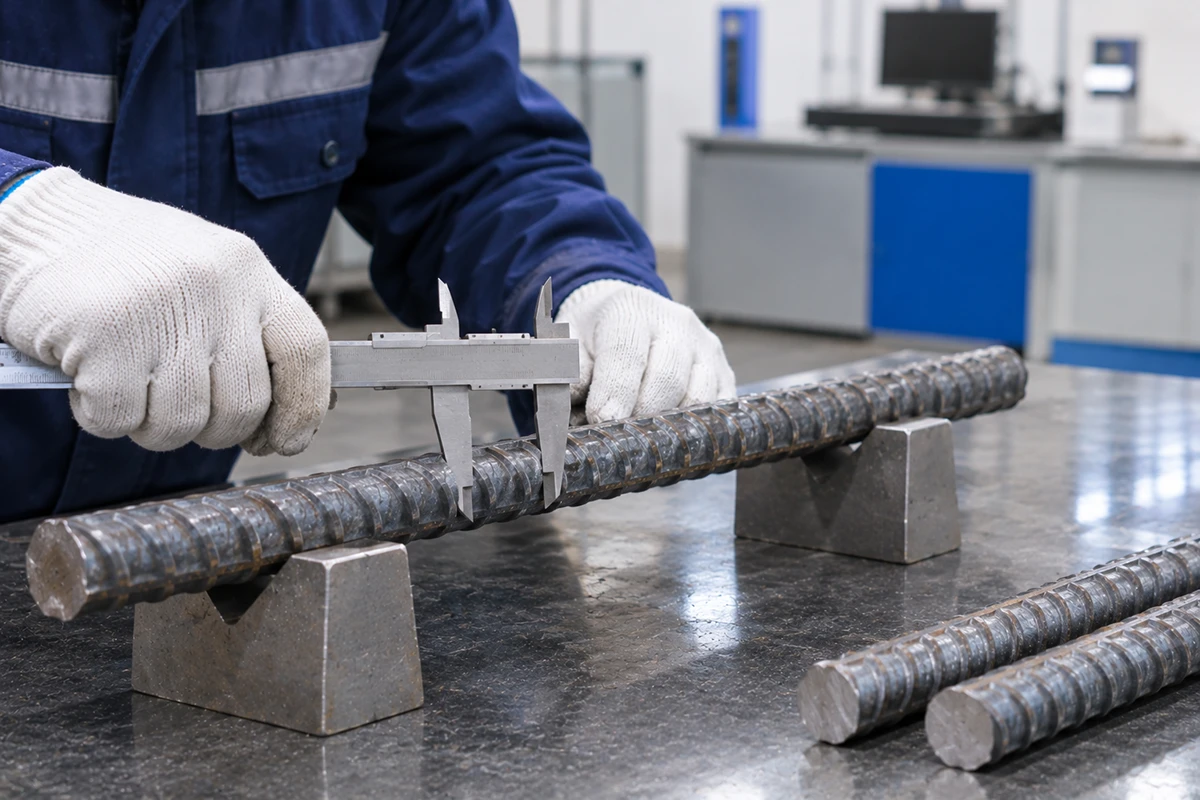
Visual inspection helps verify the ribbed surface and marking legibility; the MTC and test results establish grade compliance.
Rib geometry promotes concrete bond, while dimensional acceptance is governed by the referenced standard and sampling procedure.
Mandrel diameter varies with strength class and nominal diameter; confirm the corresponding test method and accepted result.
E-grade inspection includes a reverse-bend test. Test conditions and acceptance follow the contracted standard edition.
Match the physical delivery format to steel-fixing operations, project handling equipment and receiving constraints.
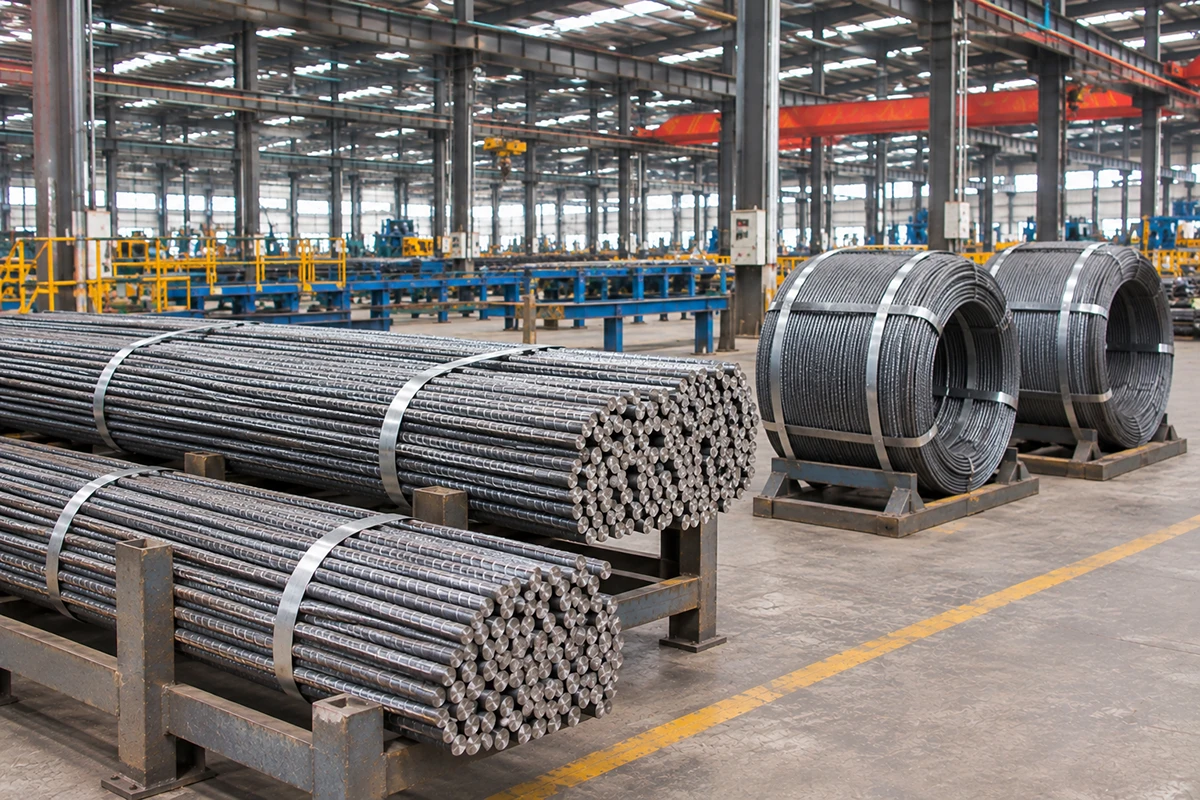
Send your drawing schedule or dimensional list. Our sales team will review each grade and line item for quotation.
The material must align with the engineer-approved structural design, local code acceptance and the project specification.

Application image is representative and does not attest to a grade or project certification.
Grade-based selection: HRB400 and HRB500 represent two nominal yield-strength classes. HRB400E and HRB500E add measured ductility and strength-ratio requirements where required by the structural specification.
Engineering review: bar spacing, anchorage, lap lengths, splices, bending and approvals should follow the design documents. Grade or national-standard substitutions are reviewed by the authorized design professional.
Specified bar diameters and grades for concrete footings, foundation mats and pile-cap cages.
Longitudinal and transverse reinforcement arranged by the approved structural design.
Material schedules for structural elements where strength class and ductility are explicitly specified.
Rebar grades, inspection requirements and any project-specified fatigue tests.
Repetitive reinforcement cut lengths, cages and compatible fabrication schedules.
Grade- and diameter-specific replenishment for distributors and procurement contractors.
Company-level manufacturing and inventory scale can support quotation coordination, inspection documentation and export planning.
8 million metric tons of annual steel output across the company, with the exact rebar grade production route confirmed for each order.
1 million metric tons of combined regular steel inventory; grade-specific diameter stock and lead time require verification.
Quote planning can include agreement on test items, lot traceability, MTC and independent inspection when requested.
Specify your destination, shipment method, packaging and documentation so logistics terms can be reviewed up front.
Estimate nominal metric tons by selecting a GB rebar diameter, single-bar length and number of pieces.
Nominal estimate for planning only. Confirm supply weight basis, permissible deviations and final packing list.
Nominal total weight (kg) = unit mass (kg/m) × cut length (m) × piece count. Divide the result by 1,000 to obtain metric tons.
2.470 kg/m × 12 m × 100 = 2,964 kg = 2.964 MT. This is a nominal planning weight and excludes allowances for fabrication loss, packaging or receiving discrepancies.
Manufacturing and delivery arrangements are confirmed against each grade, diameter and shipment requirement.

Plan the size mix, phased deliveries and packing requirements before committing to a construction schedule.
Reliable planning begins with the size schedule. Share the required tonnage by grade and diameter, target shipment date, destination and any fabrication constraints. The team can check stock, manufacturing allocation and shipment preparation for the particular enquiry.
The published company-wide inventory of 1 million MT spans multiple steel categories; it does not imply that every HRB grade or size is immediately available.
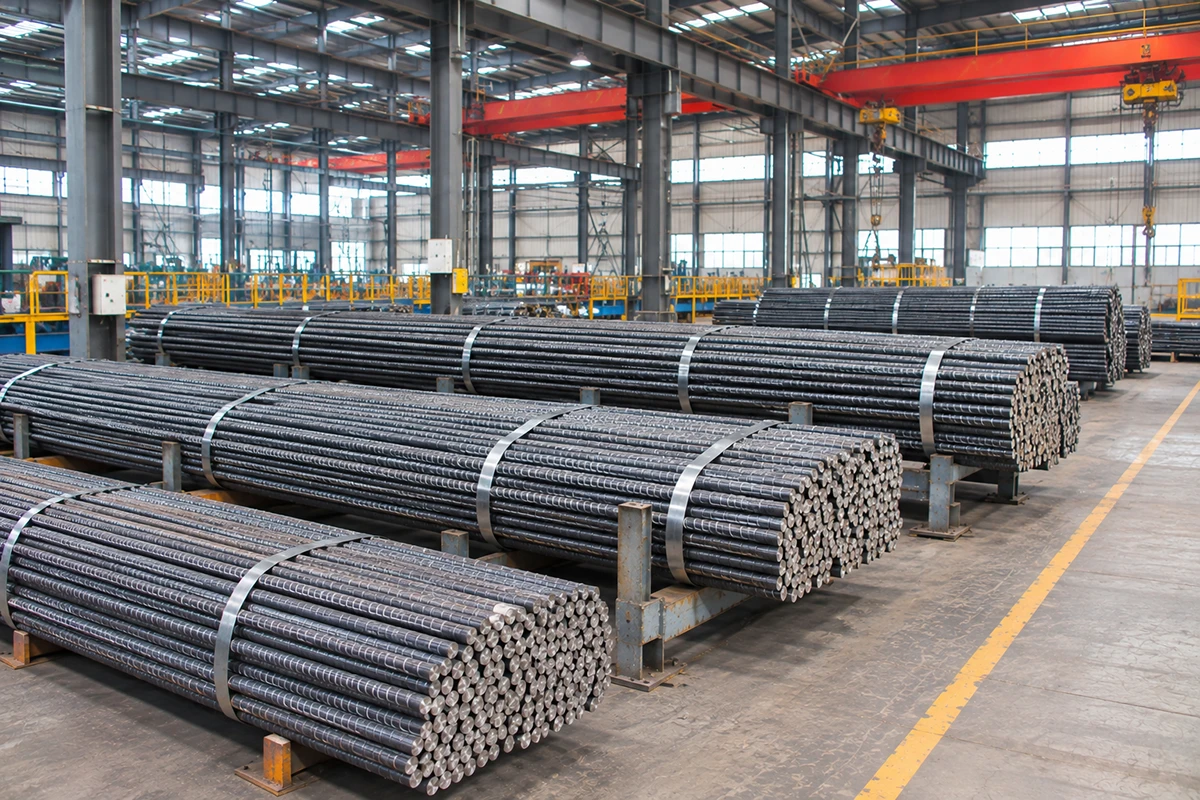
Make acceptance criteria explicit in the purchase order; the exact certificate and test scope are confirmed for each heat and inspection lot.

For projects with specified fatigue action, connections or welds, define the applicable reports and procedures (including GB/T 28900, JGJ 18 or JGJ 107 as relevant) during technical review. No general rebar listing substitutes for project-specific acceptance.
Packaging and documentation should support traceability from the mill through receipt at the project or warehouse.
Confirm tie arrangement, nominal size, grade, cut length, heat or lot reference, bundle piece count and tag format before dispatch.
Plan lifting points, bundle weights, loading restraints and any protective handling requirements appropriate to the route and destination.
Specify the MTC, packing list, commercial invoice and other agreed shipment documents, including any independent inspection reporting.
Precise grade, dimension and acceptance information reduces technical revisions and supply delays.
Our team will confirm the exact material, available supply route and applicable inspection documents before pricing.
Use dedicated pages when your project calls for grade-specific mechanical properties or a different national standard.
GB and ASTM rebar use different grade designations, dimensional conventions and acceptance requirements. A strength number alone is insufficient to authorize substitution; confirm approval with the project design authority.
Key answers on grade, seismic-grade performance, weight estimates, documentation and project acceptance.
Send the GB 1499.2-2024 grade, bar diameters, lengths, quantity schedule, MTC requirements and delivery destination. We will review the technical specification for bulk supply pricing.
GB grade · Ø size schedule · cut length · quantity/MT · E-grade testing if applicable · inspection documents · port / Incoterm
Exact stock, manufacturing route, MTC and shipment terms are confirmed by quotation.
Send your required grade, dimensions, quantity and destination. Our team will review the inquiry.